
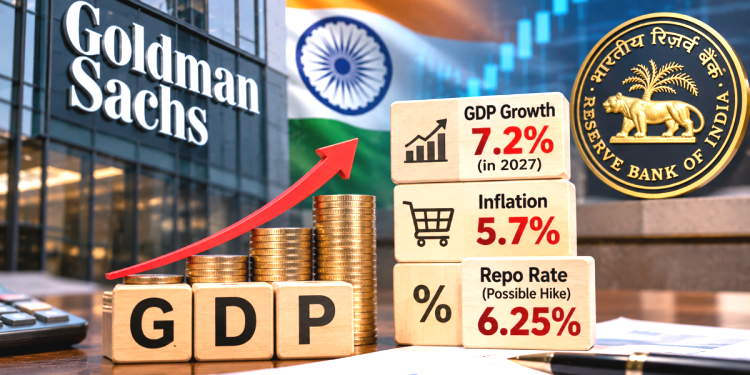
Goldman Sachs projects a slowdown in India’s economic growth next year compared to 2026
Barak Bani Digital Desk, Silchar, November 23: After a relatively comfortable 2026, India could face fresh economic challenges in 2027, with inflationary pressures expected to intensify and economic growth likely to moderate. A recent report by renowned US financial services firm Goldman Sachs has projected a significant rise in consumer inflation, raising concerns over the possibility of higher prices of essential commodities and increased borrowing costs for households.
According to the firm’s forecast, India’s consumer price inflation could climb to 5.7 per cent in 2027. To contain the rising inflationary pressure, the Reserve Bank of India (RBI) may be compelled to tighten its monetary policy by increasing interest rates. Goldman Sachs expects the RBI’s repo rate to rise to 6.25 per cent by the end of 2027. Such a move could increase borrowing costs for banks’ customers, adding to the financial burden of middle-class households through higher home loan and car loan EMIs.
According to Goldman Sachs’ economic assessment, India’s Gross Domestic Product (GDP) growth is expected to remain robust at around 7.9 per cent in 2026. However, the pace of expansion could moderate in the following year. The US financial institution has projected India’s GDP growth to decline to 7.2 per cent in 2027. Although this would still represent a relatively strong growth rate in the context of the global economy, the anticipated moderation has drawn attention among economic observers.
Why Could Prices Rise Again?
Consumers enjoyed some relief in 2026, with retail inflation estimated at around 4.6 per cent. However, Goldman Sachs expects this relatively comfortable situation to change in 2027, with inflation potentially rising to 5.7 per cent.
The report has identified two major factors that could contribute to the renewed inflationary pressure. The first is the possible impact of El Niño on global weather patterns. Unfavourable climatic conditions and deficient rainfall could adversely affect agricultural production, potentially pushing up the prices of essential food items such as rice, pulses and vegetables.
The second factor is the continuing rise in the prices of various industrial and agricultural inputs and raw materials. Higher production costs could eventually translate into increased prices of consumer goods, placing additional pressure on household budgets.
RBI May Be Forced to Tighten Monetary Policy
With inflation projected to move upwards, the Reserve Bank of India may have to adopt a more restrictive monetary policy to contain price pressures and manage liquidity in the financial system. Goldman Sachs has forecast that the RBI could increase the repo rate to 6.25 per cent by the end of 2027. The report’s projection indicates the possibility of a further increase of at least 50 basis points from the prevailing rate of 5.75 per cent.
If the central bank raises the repo rate, commercial banks could also increase lending rates, depending on their lending benchmarks and funding costs. This would directly affect borrowers, particularly those servicing home loans, car loans and other interest-linked credit facilities. For middle-class families already managing rising household expenses, higher EMIs could create additional financial pressure.
Rupee Expected to Remain Relatively Stable Against the Dollar
Despite continuing volatility in global financial markets, Goldman Sachs has offered a relatively stable outlook for the Indian rupee. The firm estimates that the domestic currency could remain around Rs 96 against the US dollar over the next 12 months. The report has highlighted India’s strong services exports and substantial remittance inflows from Indians working overseas as important factors helping the country manage pressure on its currency. These foreign exchange inflows have provided support to the rupee amid uncertainties in international markets.
Corporate Profits and Investments Offer a Silver Lining
Despite the possibility of rising inflation and higher interest rates, Goldman Sachs has presented a relatively encouraging outlook for India’s corporate sector and investment activity. According to the firm’s estimates, capital expenditure by companies included in the National Stock Exchange’s (NSE) Nifty 500 index has already increased by 17 per cent, marking the second-highest level of growth in the past decade. This indicates that domestic companies are continuing to invest substantially in infrastructure development, capacity expansion and future business growth.
The report has also projected that profit growth among companies included in the MSCI India Index could reach 16 per cent in the third quarter of the 2026-27 financial year. These investment and profitability trends could provide important support to the broader economy, even as households and businesses face the challenge of higher prices and borrowing costs.
Overall, 2027 could prove to be a challenging year for the Indian economy. Policymakers will have to navigate the twin pressures of moderating GDP growth and rising inflation while ensuring that domestic investment and corporate profitability maintain their momentum.
According to Goldman Sachs’ assessment, if the positive trends in corporate investment and business earnings continue, India’s underlying economic strength could remain intact despite the anticipated short-term challenges. For ordinary households, however, the key concern will be whether the projected rise in inflation and interest rates translates into another round of pressure on everyday expenses and monthly loan repayments.

 Barak Bani Dainik